 |
Elementa v8.0.0
Minimalistic library for any C++ application (C++11 and up)
|
|
Elementa v8.0.0
Minimalistic library for any C++ application (C++11 and up)
|
Context-free grammars: definitions, manipulations, etc.

Classes | |
| class | elementa::parsing::CFGrammar |
| A context-free grammar. More... | |
| class | elementa::parsing::Szer_CFGrammarSpec |
| Serializations of CFGrammars specified in a certain textual language. More... | |
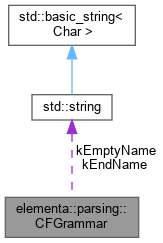
| class elementa::parsing::CFGrammar |
A context-free grammar.
This class maintains the grammar in an efficient representation (using integers for element identifiers) but it can also hold string names associated to the grammar elements. Both can be maintained separately and each one used independently.
It also can categorize elements (terminals and non-terminals) in different groups, which can be useful for parsing.
Efficiency of O(1) in many consults is achieved at the cost of increasing memory use (a bunch of bytes per grammar element -terminals, non-terminals and rules- are stored), which is reasonable for human-readable grammar sizes.
Definition at line 70 of file cfgrammars.h.
Static Public Member Functions | |
Class methods | |
| static bool | isNonTerminal (CodeElement c) noexcept |
| Return TRUE if C is a valid non-terminal code for any grammar. More... | |
| static bool | isTerminal (CodeElement c, bool extended=false) noexcept |
| Return TRUE if C is a valid terminal code for any grammar. More... | |
| static void | checkRule (const Rule &r) |
| Check that the rule R is well constructed for any possible grammar. More... | |
| static bool | isRuleHeader (const Rule &r, CodeElement left, CodeElement firstright) |
| Check whether R has LEFT at its left and FIRSTRIGHT at its first right. More... | |
| static bool | hasRuleFirstRight (const Rule &r, CodeElement firstright) |
| Check whether the given rule has as first right-side element FIRSTRIGHT. More... | |
Public Member Functions | |
Constructors | |
| CFGrammar (void) | |
| Default constructor: empty grammar. More... | |
| CFGrammar (const CFGrammar &)=delete | |
| CFGrammar (CFGrammar &&)=delete | |
| CFGrammar & | operator= (const CFGrammar &)=delete |
| CFGrammar & | operator= (CFGrammar &&)=delete |
| virtual | ~CFGrammar (void)=default |
| Destructor. | |
General consulting methods | |
| size_t | sizeTerminals (void) const noexcept |
| Return the number of terminals in the grammar. More... | |
| size_t | sizeNonTerminals (void) const noexcept |
| Return the number of non-terminals in the grammar. More... | |
| bool | existsTerminal (CodeElement c) const |
| Return TRUE if the given code is of a registered terminal. More... | |
| bool | existsNonTerminal (CodeElement c) const |
| Return TRUE if the given code is of a registered non-terminal. More... | |
| size_t | sizeTerminals (int cat) const |
| Return the number of terminals in a category. More... | |
| size_t | sizeNonTerminals (int cat) const |
| Return the number of non-terminals in a category. More... | |
| bool | existsTerminalCategory (int cat) const |
| Return FALSE if the given terminal category does not exists in the gr. More... | |
| bool | existsNonTerminalCategory (int cat) const |
| Return FALSE if the given non-terminal category does not exists in gr. More... | |
| bool | existsTerminalCatID (const CatId &catid) const |
| Return FALSE if the given terminal cat/id does not exists in the gr. More... | |
| bool | existsNonTerminalCatID (const CatId &catid) const |
| Return FALSE if the given non-terminal cat/id does not exists in gr. More... | |
| CodeElement | codeOfTerminal (const CatId &catid) const |
| Return the code corresponding to the given category and index of a term. More... | |
| CodeElement | codeOfNonTerminal (const CatId &catid) const |
| Return the code corresponding to the given category/index of a non-term. More... | |
| CatId | catidOfTerminal (CodeElement c) const |
| Return the catid corresponding to a given terminal element. More... | |
| CatId | catidOfNonTerminal (CodeElement c) const |
| Return the catid corresponding to a given non-terminal element. More... | |
| int | catOfTerminal (CodeElement c) const |
| Return the category only corresponding to a given terminal element. More... | |
| int | catOfNonTerminal (CodeElement c) const |
| Return the category only corresponding to a given non-terminal element. More... | |
| const RHSs & | rightsOf (CodeElement n) const |
| Return a reference to all the rules associated to a non-terminal N. More... | |
| CodeElement | starting (void) const |
| Return the code for the non-terminal that is the starting symbol. More... | |
| std::string | nameOfTerminal (CodeElement c) const |
| Return a copy of the name associated to the terminal C. More... | |
| std::string | nameOfNonTerminal (CodeElement c) const |
| Return a copy of the name associated to the non-terminal C. More... | |
Iterating methods | |
| RuleIterator | begin (void) const |
| Return an iterator to the first rule in the grammar. More... | |
| RuleIterator | end (void) const |
| Return an iterator past the last rule in the grammar. More... | |
| elementa::base::IotaView< CodeElement > | terminalRange (void) const noexcept |
| Return an IotaView to iterate on the current terminals. More... | |
| elementa::base::IotaView< CodeElement > | nonTerminalRange (void) const noexcept |
| Return an IotaView to iterate on the current non-terminals. More... | |
| elementa::base::IotaView< int > | terminalCatRange (void) const noexcept |
| Return an IotaView to iterate on the current terminal categories. More... | |
| elementa::base::IotaView< int > | nonTerminalCatRange (void) const noexcept |
| Return an IotaView to iterate on the current non-terminal categories. More... | |
| elementa::base::IotaView< int > | terminalCatIDRange (int cat) const |
| Return an IotaView to iterate on the current ids of a terminal category. More... | |
| elementa::base::IotaView< int > | nonTerminalCatIDRange (int cat) const |
| Return an IotaView to iterate on the current ids of a non-terminal cat. More... | |
Element searching methods | |
| CodeElement | findNonTerminal (const std::string &name) const |
| Return the code for non-terminal called NAME,or kCodeEmpty if not found. More... | |
| CodeElement | findTerminal (const std::string &name) const |
| Return the code for a terminal called NAME, or kCodeEmpty if not found. More... | |
Conversion to string methods | |
| std::string | to_string (const SetOfElements &soe) const |
| Return a string with the given set of alements (their names). | |
| std::string | to_string (const MapOfElements &moe) const |
| Return a string with the given map of elements. | |
| std::string | to_string (const RHS &rhs) const |
| Return a string with the sequence of elements in the given rhs. | |
| std::string | to_string (const Rule &r) const |
| Return a string with the given rule expressed with its names. | |
| std::string | to_string (const LL1Table t) const |
| Return a string representation of an LL(1) table. | |
Modifying methods | |
| void | clear (void) |
| Delete all the current content of the grammar. | |
| CodeElement | addTerminal () |
| Register a new termninal. More... | |
| CodeElement | addNonTerminal () |
| Register a new non-terminal. More... | |
| void | addRule (const Rule &r) |
| Add a new rule for a non-terminal. More... | |
| void | assignName (CodeElement c, const std::string &name) |
| Assign a name to an element. More... | |
| int | newTerminalCategory (void) |
| Create a new category where the next terminals will be placed. More... | |
| int | newNonTerminalCategory (void) |
| Create a new category where the next non-terminals will be placed. More... | |
Procedures (it is recommended to use checkIntegrity() first) | |
| void | checkIntegrity (bool withnames=true) const |
| Check that the content of the grammar is properly filled. More... | |
| bool | directlyLeftRecursive (Rule &r) const |
| Check direct left-recursivity in the grammar. More... | |
| bool | leftRecursive (CodeElement &rec) const |
| Check any left-recursivity, direct or not. More... | |
| void | calculateFirsts (MapOfElements &firsts) const |
| Fill FIRSTS with the first sets of all non-terminals in the grammar. More... | |
| void | firstOfRHS (const RHS &rhs, const MapOfElements &firsts, SetOfElements &f) const |
| Fill F with the first set of the entire RHS, according to FIRSTS. More... | |
| void | calculateFollows (const MapOfElements &firsts, MapOfElements &follows, std::string *trace=nullptr) const |
| Fill FOLLOWS with the follow sets of all non-terminals in the grammar. More... | |
| void | firstFirstConflicts (const MapOfElements &firsts, SetOfElements &nts) const |
| Fill in NTS with the non-terminals that cause first-first conflicts. More... | |
| void | firstFollowConflicts (const MapOfElements &firsts, const MapOfElements &follows, MapOfElements &nts) const |
| Fill in NTS with the terminals shared in firsts and follows of non-term. More... | |
| bool | isLL1 (const MapOfElements &firsts, const MapOfElements &follows, SetOfElements &fifi, MapOfElements &fifo) const |
| Return TRUE if the grammar is LL(1). More... | |
| void | fillLL1Table (const MapOfElements &firsts, const MapOfElements &follows, LL1Table &table) const |
| Try to fill TABLE with the parsing table of the grammar. More... | |
Types, consts, etc. | |
| using | CodeElement = TokenId |
| Unique code of an element of the grammar, either terminal or non-term. More... | |
| using | SetOfElements = std::set< CodeElement > |
| Set of elements. More... | |
| using | MapOfElements = std::map< CodeElement, SetOfElements > |
| Set of elements associated to another element. More... | |
| using | VectorOfElements = std::vector< CodeElement > |
| Vector of elements. More... | |
| using | RHS = VectorOfElements |
| The right-hand side of a rule of the grammar. More... | |
| using | RHSs = std::vector< RHS > |
| A number of RHS (usually for the same left hand side non-terminal). More... | |
| using | MapOfRules = std::map< CodeElement, RHSs > |
| A mapping from left-side non-terminals to vectors of right sides. More... | |
| using | Rule = std::pair< CodeElement, RHS > |
| A rule in the grammar (only one alternative for the left side). More... | |
| using | LL1Table = std::map< LL1TableIndex, RuleIterator > |
| An LL(1) parsing table (sparse). More... | |
| static const CodeElement | kCodeEmpty |
| Code of the "empty" element. More... | |
| static const CodeElement | kCodeEnd |
| Code of the "end of source" el. More... | |
| static const std::string | kEmptyName |
| A name for the "empty" element. More... | |
| static const std::string | kEndName |
| A name for the "end of source" elem. More... | |
Unique code of an element of the grammar, either terminal or non-term.
Terminals: in the range [-2, -inf). Non-terms: in the range [1 , +inf). The values 0 and -1 are reserved: 0 is "empty" and -1 is "end of source".
Definition at line 97 of file cfgrammars.h.
| using elementa::parsing::CFGrammar::SetOfElements = std::set<CodeElement> |
Set of elements.
Definition at line 100 of file cfgrammars.h.
| using elementa::parsing::CFGrammar::MapOfElements = std::map<CodeElement,SetOfElements> |
Set of elements associated to another element.
Definition at line 103 of file cfgrammars.h.
| using elementa::parsing::CFGrammar::VectorOfElements = std::vector<CodeElement> |
Vector of elements.
Definition at line 106 of file cfgrammars.h.
The right-hand side of a rule of the grammar.
It may be empty. It contains the right hand side of just one rule.
Definition at line 110 of file cfgrammars.h.
| using elementa::parsing::CFGrammar::RHSs = std::vector<RHS> |
A number of RHS (usually for the same left hand side non-terminal).
Definition at line 113 of file cfgrammars.h.
| using elementa::parsing::CFGrammar::MapOfRules = std::map<CodeElement, RHSs> |
A mapping from left-side non-terminals to vectors of right sides.
Definition at line 116 of file cfgrammars.h.
| using elementa::parsing::CFGrammar::Rule = std::pair<CodeElement,RHS> |
A rule in the grammar (only one alternative for the left side).
Definition at line 119 of file cfgrammars.h.
| using elementa::parsing::CFGrammar::LL1Table = std::map<LL1TableIndex,RuleIterator> |
An LL(1) parsing table (sparse).
Definition at line 287 of file cfgrammars.h.
|
inline |
Default constructor: empty grammar.
Definition at line 340 of file cfgrammars.h.
References clear().
|
inlinestaticnoexcept |
Return TRUE if C is a valid non-terminal code for any grammar.
Definition at line 304 of file cfgrammars.h.
References kCodeEmpty.
Referenced by elementa::parsing::CFGrammar::LL1TableIndex::LL1TableIndex(), and existsNonTerminal().
|
inlinestaticnoexcept |
Return TRUE if C is a valid terminal code for any grammar.
| extended | indicates whether to consider the special codes 'empty' and 'end' as terminals or not. |
Definition at line 310 of file cfgrammars.h.
References kCodeEmpty, and kCodeEnd.
Referenced by elementa::parsing::CFGrammar::LL1TableIndex::LL1TableIndex(), and existsTerminal().
|
static |
Check that the rule R is well constructed for any possible grammar.
If not ok, throw an std::invalid_argument exception. It does not check whether the rule is correct if inserted in the grammar (e.g., not repeated w.r.t. other rule).
|
static |
Check whether R has LEFT at its left and FIRSTRIGHT at its first right.
Return TRUE if that is the case. FIRSTRIGHT may be kCodeEmpty to indicate empty right side. This method is useful in some grammars, e.g., LL(1), where the left plus the first right may be enough to identify a rule completely.
|
static |
Check whether the given rule has as first right-side element FIRSTRIGHT.
Return TRUE if that is the case. FIRSTRIGHT may be kCodeEmpty to indicate empty right side.
|
inlinenoexcept |
Return the number of terminals in the grammar.
Definition at line 357 of file cfgrammars.h.
References kCodeEnd.
Referenced by nonTerminalRange().
|
inlinenoexcept |
Return the number of non-terminals in the grammar.
Definition at line 361 of file cfgrammars.h.
References kCodeEmpty.
Referenced by terminalRange().
|
inline |
Return TRUE if the given code is of a registered terminal.
This is O(1). Throw if C is not a proper terminal code.
Definition at line 366 of file cfgrammars.h.
References isTerminal().
Referenced by catidOfTerminal(), and catOfTerminal().
|
inline |
Return TRUE if the given code is of a registered non-terminal.
This is O(1). Throw if C is not a proper non-terminal code.
Definition at line 371 of file cfgrammars.h.
References isNonTerminal().
Referenced by catidOfNonTerminal(), and catOfNonTerminal().
|
inline |
Return the number of terminals in a category.
Definition at line 375 of file cfgrammars.h.
References ELE_CODE_INVARG, and existsTerminalCategory().
|
inline |
Return the number of non-terminals in a category.
Definition at line 381 of file cfgrammars.h.
References ELE_CODE_INVARG, and existsTerminalCategory().
|
inline |
Return FALSE if the given terminal category does not exists in the gr.
The first possible valid category is 0. This is O(1).
Definition at line 389 of file cfgrammars.h.
Referenced by existsNonTerminalCatID(), existsTerminalCatID(), sizeNonTerminals(), sizeTerminals(), and terminalCatIDRange().
|
inline |
Return FALSE if the given non-terminal category does not exists in gr.
The first possible valid category is 0. This is O(1).
Definition at line 396 of file cfgrammars.h.
Referenced by nonTerminalCatIDRange().
|
inline |
Return FALSE if the given terminal cat/id does not exists in the gr.
The first possible valid ID is 0. This is O(1).
Definition at line 403 of file cfgrammars.h.
References existsTerminalCategory().
Referenced by codeOfTerminal().
|
inline |
Return FALSE if the given non-terminal cat/id does not exists in gr.
The first possible valid ID is 0. This is O(1).
Definition at line 411 of file cfgrammars.h.
References existsTerminalCategory().
Referenced by codeOfNonTerminal().
|
inline |
Return the code corresponding to the given category and index of a term.
Throw if catid is invalid. This is O(1).
Definition at line 418 of file cfgrammars.h.
References ELE_CODE_PLACE, and existsTerminalCatID().
|
inline |
Return the code corresponding to the given category/index of a non-term.
Throw if catid is invalid. This is O(1).
Definition at line 425 of file cfgrammars.h.
References ELE_CODE_PLACE, and existsNonTerminalCatID().
|
inline |
Return the catid corresponding to a given terminal element.
Throw if c is invalid. This is O(1).
Definition at line 432 of file cfgrammars.h.
References ELE_CODE_PLACE, and existsTerminal().
|
inline |
Return the catid corresponding to a given non-terminal element.
Throw if c is invalid. This is O(1).
Definition at line 439 of file cfgrammars.h.
References ELE_CODE_PLACE, and existsNonTerminal().
|
inline |
Return the category only corresponding to a given terminal element.
Throw if c is invalid. This is O(1).
Definition at line 447 of file cfgrammars.h.
References ELE_CODE_PLACE, and existsTerminal().
|
inline |
Return the category only corresponding to a given non-terminal element.
Throw if c is invalid. This is O(1).
Definition at line 454 of file cfgrammars.h.
References ELE_CODE_PLACE, and existsNonTerminal().
| const RHSs & elementa::parsing::CFGrammar::rightsOf | ( | CodeElement | n | ) | const |
Return a reference to all the rules associated to a non-terminal N.
This is O(log(m)), being M the number of non-terminals in the grammar. Throw if N is not a non-terminal of if it has no rules in the grammar.
| CodeElement elementa::parsing::CFGrammar::starting | ( | void | ) | const |
Return the code for the non-terminal that is the starting symbol.
The first non-terminal added to the grammar is considered the starting non-terminal. This method is O(1). This method throws if there are no non-terminals.
| std::string elementa::parsing::CFGrammar::nameOfTerminal | ( | CodeElement | c | ) | const |
Return a copy of the name associated to the terminal C.
If the code has no known name, return a name automatically created at this time for it. If the element is not in the grammar or is not a terminal, throws. This method is O(1).
| std::string elementa::parsing::CFGrammar::nameOfNonTerminal | ( | CodeElement | c | ) | const |
Return a copy of the name associated to the non-terminal C.
If the code has no known name, return a name automatically created at this time for it. If the element is not in the grammar or is not a non-terminal, throws. This method is O(1).
|
inline |
Return an iterator to the first rule in the grammar.
Definition at line 491 of file cfgrammars.h.
|
inline |
Return an iterator past the last rule in the grammar.
Definition at line 494 of file cfgrammars.h.
|
inlinenoexcept |
Return an IotaView to iterate on the current terminals.
Definition at line 498 of file cfgrammars.h.
References kCodeEnd, and sizeNonTerminals().
|
inlinenoexcept |
Return an IotaView to iterate on the current non-terminals.
Definition at line 505 of file cfgrammars.h.
References kCodeEmpty, and sizeTerminals().
|
inlinenoexcept |
Return an IotaView to iterate on the current terminal categories.
Definition at line 513 of file cfgrammars.h.
|
inlinenoexcept |
Return an IotaView to iterate on the current non-terminal categories.
Definition at line 519 of file cfgrammars.h.
|
inline |
Return an IotaView to iterate on the current ids of a terminal category.
Definition at line 525 of file cfgrammars.h.
References ELE_CODE_PLACE, and existsTerminalCategory().
|
inline |
Return an IotaView to iterate on the current ids of a non-terminal cat.
Definition at line 533 of file cfgrammars.h.
References ELE_CODE_PLACE, and existsNonTerminalCategory().
| CodeElement elementa::parsing::CFGrammar::findNonTerminal | ( | const std::string & | name | ) | const |
Return the code for non-terminal called NAME,or kCodeEmpty if not found.
This is O(log(m)), being M the number of non-terminals in the grammar that have a name. This method does not work with automatically-generated element names. If the name is found but associated to a terminal, an exception is thrown.
| CodeElement elementa::parsing::CFGrammar::findTerminal | ( | const std::string & | name | ) | const |
Return the code for a terminal called NAME, or kCodeEmpty if not found.
This is O(log(m)), being M the number of terminals in the grammar that have a name. This method does not work with automatically-generated element names. If the name is found but associated to a non-terminal, an exception is thrown.
| CodeElement elementa::parsing::CFGrammar::addTerminal | ( | ) |
Register a new termninal.
This is O(1).
| CodeElement elementa::parsing::CFGrammar::addNonTerminal | ( | ) |
Register a new non-terminal.
This is O(1).
| void elementa::parsing::CFGrammar::addRule | ( | const Rule & | r | ) |
Add a new rule for a non-terminal.
If there are some more rules for the same non-terminal already, this one is merged (if it is the same as another one, an error is thrown). This is O( R*r + log(n) ), being R the number of rules in the grammar, 'r' the length of the right side of the input argument and N the number of non-terminals in the grammar.
| void elementa::parsing::CFGrammar::assignName | ( | CodeElement | c, |
| const std::string & | name | ||
| ) |
Assign a name to an element.
If the element does not appear yet in the grammar, throws. This is O(log(m)), being M the number of elements of the same kind (terminals or non-terminals) in the grammar.
| int elementa::parsing::CFGrammar::newTerminalCategory | ( | void | ) |
Create a new category where the next terminals will be placed.
Return the new category created. A category is just an integer value to grouping terminals. While this method is not called, all terminals are assigned the same category, starting at 0. If adding a new category would leave the previous one empty, throws.
| int elementa::parsing::CFGrammar::newNonTerminalCategory | ( | void | ) |
Create a new category where the next non-terminals will be placed.
Return the new category created. A category is just an integer value to grouping non-terminals. While this method is not called, all non-terminals are assigned the same category, starting at 0. If adding a new category would leave the previous one empty, throws.
| void elementa::parsing::CFGrammar::checkIntegrity | ( | bool | withnames = true | ) | const |
Check that the content of the grammar is properly filled.
If WITHNAMES == TRUE also check integrity of the names. If some error is detected, an elementa::base::invalid_state error is thrown.
| bool elementa::parsing::CFGrammar::directlyLeftRecursive | ( | Rule & | r | ) | const |
Check direct left-recursivity in the grammar.
Check whether there is some rule(s) of the form A : A... and, if there is any, return TRUE and copy into R first one that is found.
| bool elementa::parsing::CFGrammar::leftRecursive | ( | CodeElement & | rec | ) | const |
Check any left-recursivity, direct or not.
If it is left-recursive, return TRUE and fill REC with the first non- terminal that produces left-recursivity.
| void elementa::parsing::CFGrammar::calculateFirsts | ( | MapOfElements & | firsts | ) | const |
Fill FIRSTS with the first sets of all non-terminals in the grammar.
FIRST(c) == set of elements of the grammar that will be produced in the first place when derived from C, including kEmptyCode and kEndCode. This method does not calculate firsts of terminals since the first set of a terminal is just the same terminal.
| void elementa::parsing::CFGrammar::firstOfRHS | ( | const RHS & | rhs, |
| const MapOfElements & | firsts, | ||
| SetOfElements & | f | ||
| ) | const |
Fill F with the first set of the entire RHS, according to FIRSTS.
You must call previously calculateFirsts().
| void elementa::parsing::CFGrammar::calculateFollows | ( | const MapOfElements & | firsts, |
| MapOfElements & | follows, | ||
| std::string * | trace = nullptr |
||
| ) | const |
Fill FOLLOWS with the follow sets of all non-terminals in the grammar.
FOLLOWS(c) == set of elements of the grammar that will be produced after any derivation of C. This method needs a previous calculation of first sets. If TRACE != nullptr, clears TRACE and fills it with a trace of how each follow set has been calculated. This is handy for debugging grammars when there are fi-fo conflicts, since each line in TRACE indicates a reason why a terminal is in the follow set of some non-terminal.
| void elementa::parsing::CFGrammar::firstFirstConflicts | ( | const MapOfElements & | firsts, |
| SetOfElements & | nts | ||
| ) | const |
Fill in NTS with the non-terminals that cause first-first conflicts.
A first-first conflict happens when a non-terminal has alternatives that begins with the same terminal according to the given FIRST set. It is an indication of left recursivity in the grammar.
| void elementa::parsing::CFGrammar::firstFollowConflicts | ( | const MapOfElements & | firsts, |
| const MapOfElements & | follows, | ||
| MapOfElements & | nts | ||
| ) | const |
Fill in NTS with the terminals shared in firsts and follows of non-term.
Each index in NTS will be a non-terminal, while its second part will be the set of terminals that appear both in the first and follow sets of it. A first-follow conflict happens when a non-terminal has some alternative production that yields empty and its follow set and its first set has a non- empty intersection (when not considering the empty code element), meaning, for example, that a LL(1) grammar does not suffice to recognize that language, since longer look-ahead would be required. For instance:
    \code
    S -> a A b;
    A -> b a A | empty; // parser LL(1) cannot know, after encountering
                        // 'b', whether it should take A -> empty or
                        // A -> b a A. The FiFo conflict rises for A.
    \endcode
| bool elementa::parsing::CFGrammar::isLL1 | ( | const MapOfElements & | firsts, |
| const MapOfElements & | follows, | ||
| SetOfElements & | fifi, | ||
| MapOfElements & | fifo | ||
| ) | const |
Return TRUE if the grammar is LL(1).
A grammar is LL(1) iff there is no first-first or first-follow conflicts. This method calculates the first-first conflicts into FIFI and the first-follow conflicts into FIFO.
| void elementa::parsing::CFGrammar::fillLL1Table | ( | const MapOfElements & | firsts, |
| const MapOfElements & | follows, | ||
| LL1Table & | table | ||
| ) | const |
Try to fill TABLE with the parsing table of the grammar.
The parsing table contains, for a given non-terminal and a given terminal, the rule that should be applied during parsing that non-terminal when the next input terminal is the corresponding one. If there is more than one rule for some pair (non-terminal,terminal) in the table, this method throws (then the grammar is not LL(1): see isLL1()). Those pairs that do not have any rule are not filled -they should be considered parsing errors during parsing-.
|
static |
Code of the "empty" element.
Definition at line 289 of file cfgrammars.h.
Referenced by isNonTerminal(), isTerminal(), nonTerminalRange(), and sizeNonTerminals().
|
static |
Code of the "end of source" el.
Definition at line 291 of file cfgrammars.h.
Referenced by elementa::parsing::CFGrammar::LL1TableIndex::LL1TableIndex(), isTerminal(), sizeTerminals(), and terminalRange().
|
static |
A name for the "empty" element.
Definition at line 293 of file cfgrammars.h.
|
static |
A name for the "end of source" elem.
Definition at line 295 of file cfgrammars.h.
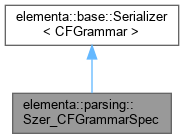
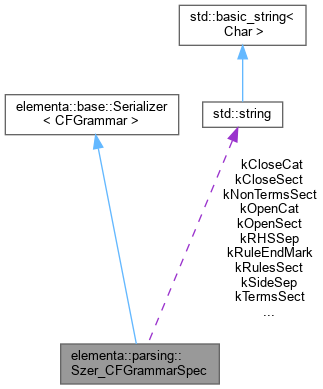
| class elementa::parsing::Szer_CFGrammarSpec |
Serializations of CFGrammars specified in a certain textual language.
This serializer deals with grammars specified in a text composed exclusively of three elements: words without separators (spc, tabs, nline, etc.), separators (spc, tabs, etc.) and comments (both multiline and uniline C-style comments, without nesting in multiline comments).
Separators are, as in most languages, ignored.
Every word must be separated from the next (if it is not the last one) and from the previous (if it is not the first one) by some separator(s).
These words must form the grammar according to the following example (terminals must be written in uppercase entirely and non-terminals in lowercase entirely; both must follow the rules of standard identifiers):
\code

Terminals:  // optional section (if omitted, all terms are in one category)
{
    { TERM1 TERM2 } // the first category of terminals; ids from 0 on.
    { TERM3 } // the second category ... items separated with separators
}

Non-terminals: // optional section (if omitted, all non-terms in one cat.)
{
    { nonterm1 } // first category of non-terminals ...
}

Rules: // mandatory section
{

    nonterm1 : TERM1 nonterm2 | TERM2 TERM3 nonterm2 | ; // spaces around |
    nonterm2 : TERM3 | ; // notice space before ';'
    // Rest of rules of the grammar...
}

\endcode
Empty alternatives to rules can be at any point in the declaration of a rule, but can only happen once in a rule.
More than one rule for a given non-terminal can be written separately (and in any order): they will be collected and merged appropriately by the de-serializer.
The non-terminal in the left-hand side of the first rule in the text will be considered the starting non-terminal in the grammar.
Definition at line 816 of file cfgrammars.h.
Public Types | |
| using | SType = CFGrammar |
| To access the Sble type parameter of this type. More... | |
| using | RDeserType = CFGrammar |
| To access the ReturnDeserType type parameter of this type. More... | |
| using | RSerType = CFGrammar |
| To access the ReturnSerType type parameter of this type. More... | |
Static Public Attributes | |
| static const std::string | kTermsSect |
| Keyword to enter the terminals section. More... | |
| static const std::string | kNonTermsSect |
| Keyword to enter the non-terminals section. More... | |
| static const std::string | kRulesSect |
| Keyword to enter the rules section. More... | |
| static const std::string | kOpenSect |
| Keyword to open any section. More... | |
| static const std::string | kCloseSect |
| Keyword to close any section. More... | |
| static const std::string | kOpenCat |
| Keyword to open any category list. More... | |
| static const std::string | kCloseCat |
| Keyword to close any category list. More... | |
| static const std::string | kSideSep |
| Text separator of left and right hand side in a default-serialized rule. More... | |
| static const std::string | kRHSSep |
| Text separator between alternatives in a default-serialized rule. More... | |
| static const std::string | kRuleEndMark |
| Text ending mark of a rule in a default-serialized rule. More... | |
Public Member Functions | |
| void | ser (elementa::base::OutSerCh &chout, const CFGrammar &cfg) |
| Serialize. | |
| void | deser (elementa::base::InSerCh &chin, CFGrammar &cfg) |
| Deserialize. | |
| virtual void | ser (OutSerCh &chout, const CFGrammar &obj) |
| Serializes an object, writing the resulting chars into CHOUT. More... | |
| virtual void | deser (InSerCh &chin, CFGrammar &obj) |
| Deserializes an object from a sequence of chars in CHIN. More... | |
|
inherited |
To access the Sble type parameter of this type.
Definition at line 193 of file serializers.h.
|
inherited |
To access the ReturnDeserType type parameter of this type.
Definition at line 196 of file serializers.h.
|
inherited |
To access the ReturnSerType type parameter of this type.
Definition at line 199 of file serializers.h.
|
inlinevirtualinherited |
Serializes an object, writing the resulting chars into CHOUT.
Must throw if any error during serialization, including channel errors (in that case, the channel can be left in the state it was when the error occurred).
Definition at line 206 of file serializers.h.
|
inlinevirtualinherited |
Deserializes an object from a sequence of chars in CHIN.
Must change the content of OBJ with the result. Throw if any error during serialization, including channel errors (in that case, the channel and the object are left in the state they were at the moment of the error).
Definition at line 214 of file serializers.h.
|
static |
Keyword to enter the terminals section.
Definition at line 869 of file cfgrammars.h.
|
static |
Keyword to enter the non-terminals section.
Definition at line 872 of file cfgrammars.h.
|
static |
Keyword to enter the rules section.
Definition at line 875 of file cfgrammars.h.
|
static |
Keyword to open any section.
Definition at line 878 of file cfgrammars.h.
|
static |
Keyword to close any section.
Definition at line 881 of file cfgrammars.h.
|
static |
Keyword to open any category list.
Definition at line 884 of file cfgrammars.h.
|
static |
Keyword to close any category list.
Definition at line 887 of file cfgrammars.h.
|
static |
Text separator of left and right hand side in a default-serialized rule.
Definition at line 890 of file cfgrammars.h.
|
static |
Text separator between alternatives in a default-serialized rule.
Definition at line 893 of file cfgrammars.h.
|
static |
Text ending mark of a rule in a default-serialized rule.
Definition at line 896 of file cfgrammars.h.
 1.9.5
1.9.5